Many-Body physics at and out-of equilibrium

Research activity of the group of Andrea Marini, at the Institute of Material Science of the National Research Council, Italy

Frontiers in Ultrafast Phenomena in Quantum Materials

Frascati (Italia), 2026, 21-24 April

The time–resolved angle–resolved photoemitton spectra of WSe, a paradigmatic metal dichalcogenide, is dominated by a peak that, initially observed withing the gap at the  valley, scatters, on an ultra–fast time scale of  fs to the S valley.
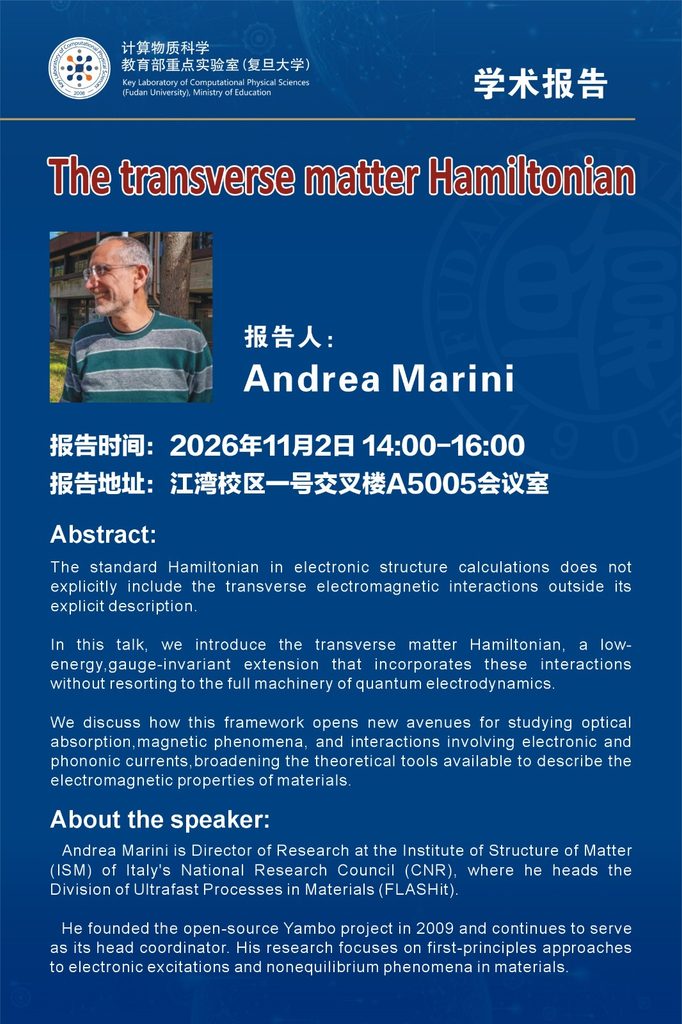
In his talk on April 24 at INFN Frascati National Laboratories, Andrea Marini will question the commonly used interpretation of the experimental observations in terms of a massive bound electron–hole exciton scattering with phonon and behaving as a quasi–particle. By using a combined theoretical and experimental investigation he will demonstrate that the observed dynamics can be interpreted as the photo–induced transition from a direct to and indirect excitonic insulating phase. The peaks that appear in the experimental spectrum correspond to single–particle levels renormalized by the excitonic spontaneous polarization.

Abstract

FAIR Data management of theoretical spectroscopy and green’s function methods

Lausanne (Switzerland), 2026, 20-23 April

Electrons and phonons are basic concepts, considered as the most elemental and well defined example of fermions and bosons. So it may appear that their formal properties are clear and well established. In reality, despite books and reviews the theory of electron-phonon interaction(EPI) is still very much debated. The reason is mostly historical. Indeed the state-of-the art theoretical and numerical approach to the EPI has been built on top of two popular methods: model Hamiltonians and Density Functional Perturbation Theory (DFPT). These popular approaches have instilled two basic assumptions that are widely used in the literature and even coded in public Ab–Initio codes.

The first assumption is that the elemental EPI Hamiltonian is well approximated by using a statically screened interaction. 

The second assumption is clearly written in a recent Review of Modern Physics of F. Giustino where he writes that “the MBPT phonon self-energy is in agreement with the expression derived starting from time-dependent density-functional perturbation theory”.

In his talk, at CECAM (Centre Européen de Calcul Atomique et Moléculaire), on April 22-22, Andrea Marini will disassemble the EPI Hamiltonian to demonstrate its stringent limitations. He will also introduce a time-dependent formulation of DFPT showing how it can be exactly rewritten as the problem of a classical pendulum immersed in a quantistic liquid (semi-classical swing). He will discuss the countless implications of such a problem linked the very basic foundations of MBPT.
He will then move to present a formal an accurate derivation 3 of the dynamical screening of the EPI. He will, in particular, demonstrate that it is possible to derive an effective vertex correction function that can be easily defined using simple ingredients and used to amend calculations based on the statically screened approximation.

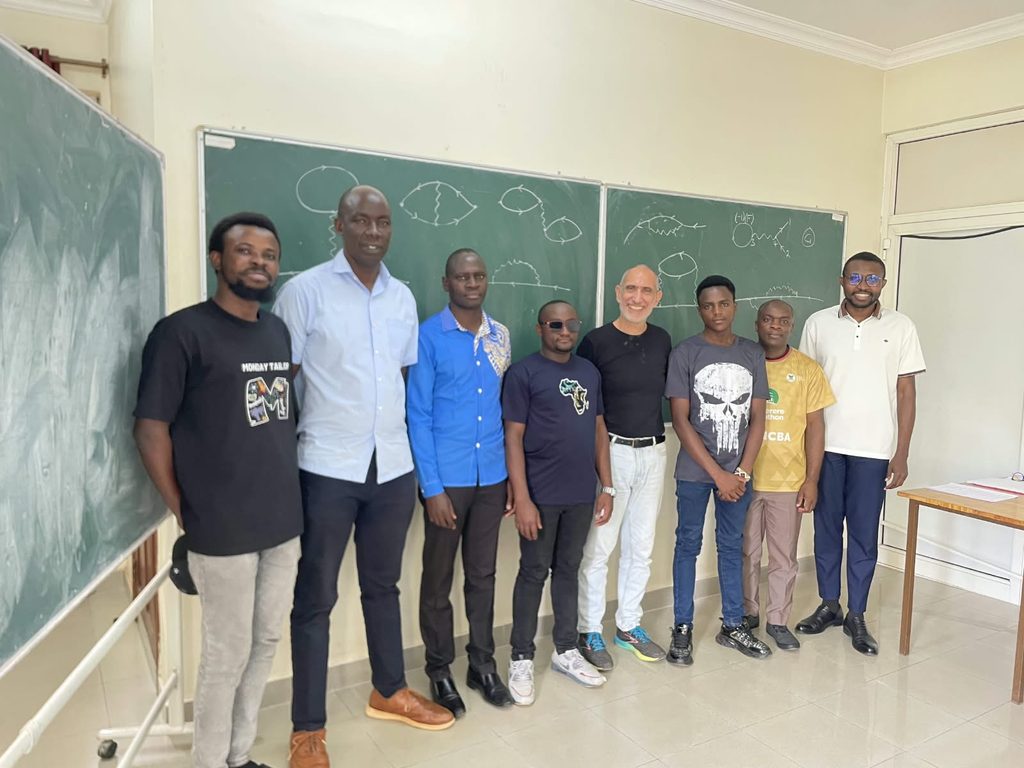
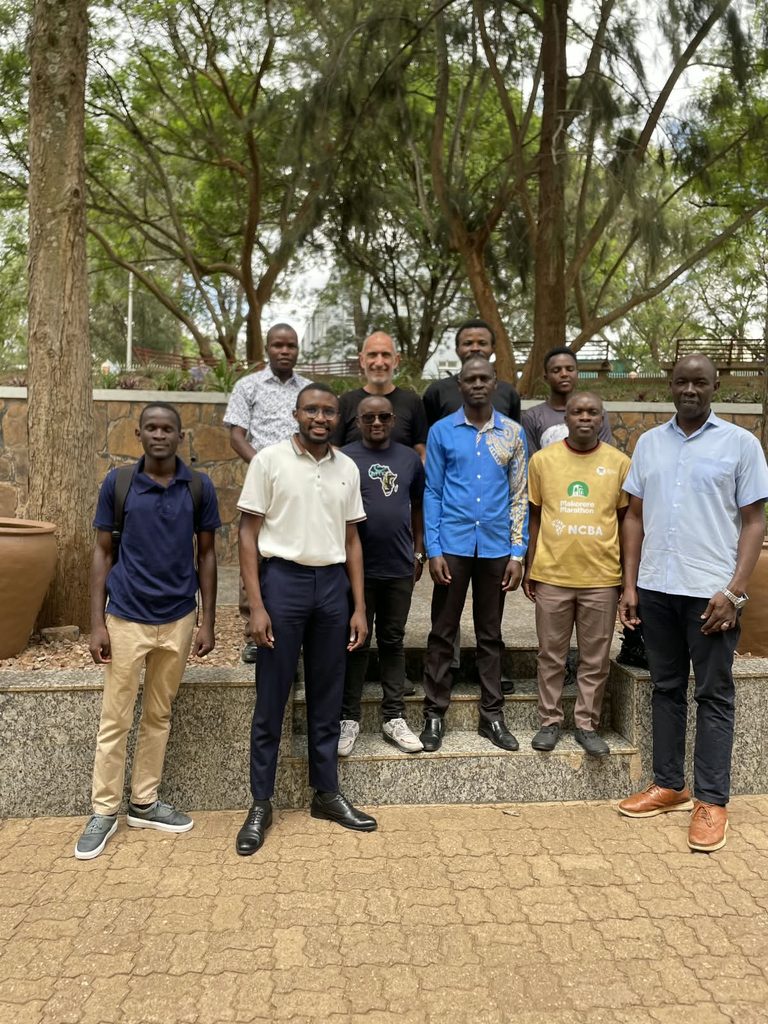
The APhRICA students grow

Kigali (Rwanda), 2025, 1-19 December

The second cycle of the APhRICA Program started. The lessons were held at the ICTP-EAIFR of the UR in Kigali.

The students and lectures answering the Call for the 2nd Cohort 2025-2027 and selected from the major Universities of Kenya and other African countries joined the students of the fist year master course in Condensed Matter Physics of ICTP-EAIFR, attending in the same class to the Quantum Mechanics I course, held by Dr. Andrea Marini. All the students were required to sign a letter of committment for the attendance and related exams of the two year training program.

They met in Kigali their collegues from the 1st ICTP-EAIFR master course in Condensed Matter Physics supported by the APhRICA Program and of the 1st Cohort (2024-2026) attending to the Quantum Mechanics II course held by Dr. Andrea Marini in the same month.

The total number of the 2 classes supported by the APhRICA program amounted to 26 participants.

APhRICA

APhRICA Launch

APhRICA training

APhRICA Cooperation Agreement

Physics Without Frontiers Workshop for APhRICA

APhRICA at PSI-K Conference

Call for the 2nd Cohort 2025-2027

Physics education in Kenya