Rome (Italy), 2026, 7-10 September
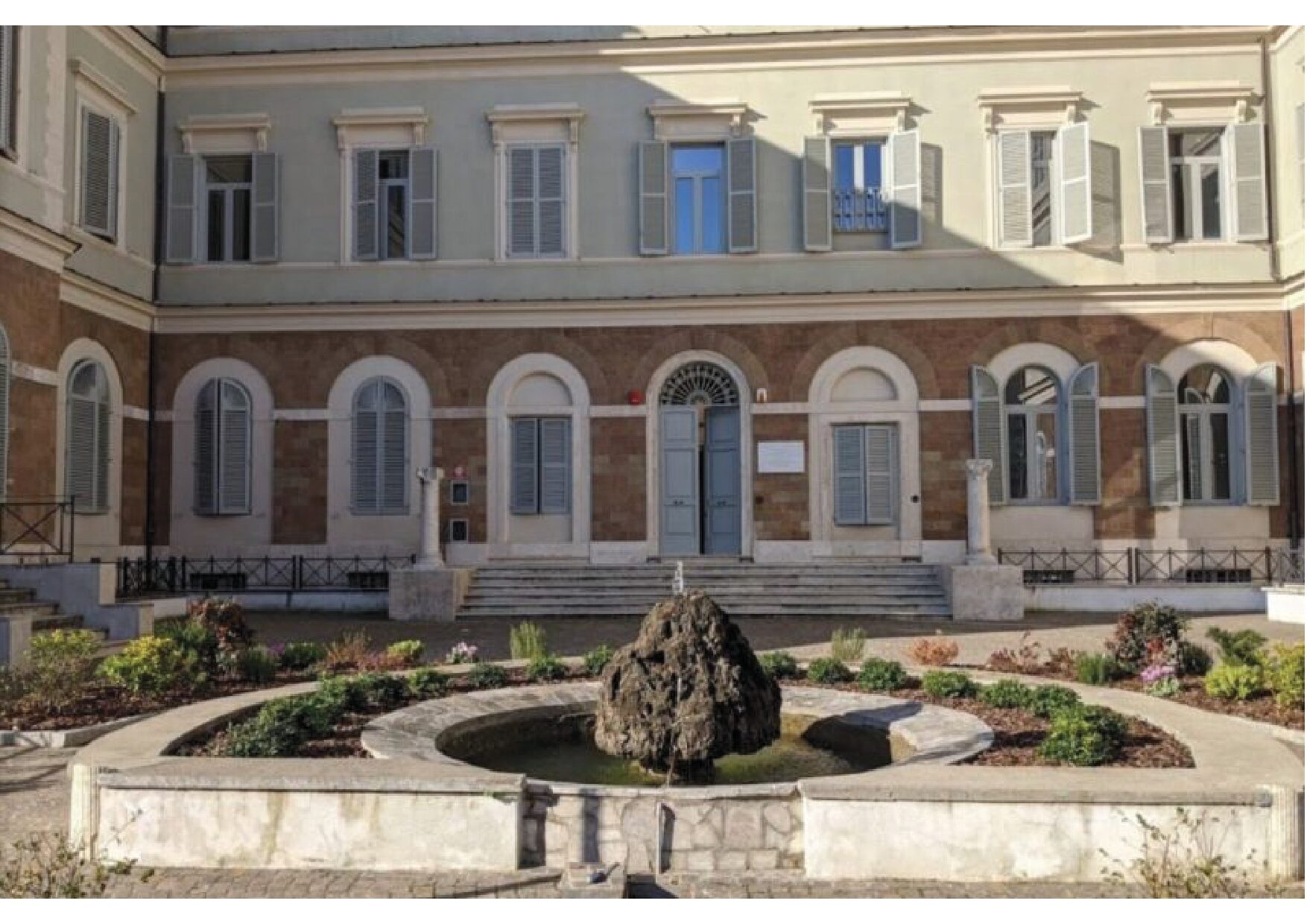
Hosted by the CNR Hall, Via dei Taurini 19, Rome, the ETSF Informal meeting 2026 was conceived as an informal appointment devoted to ongoing research, open questions, and methodological challenges in the theoretical description of electronic and excited-state phenomena in condensed matter and materials science. The workshop aimed to foster active scientific exchange in an environment that encourages open discussion and close interaction among participants.
In keeping with this spirit, speakers and session chairs were asked to follow the principle of short talks, long discussions, leaving ample time for questions and collective debate. A poster session was also organized to further stimulate interaction and exchange of ideas.
The scientific programme has covered topics including, but not limited to, electron–phonon interactions, exciton dynamics, strongly correlated systems, and complex materials, with an emphasis on methodological developments and emerging challenges in the field.
In particular, in his talk “Gauge invariant derivation of the matter–only Hamiltonian” Andrea Marini presented the following content (abstract): “Enrico Fermi in 1932, used classical Gauss equation to derive the Coloumb density–density interaction from the longitudinal electro–magnetic potential, in a gauge invariant way. In this work we extend the Fermi procedure to the transverse component of the vector potential. By using a fully quantistic canonical transformation we replace the transverse vector potential with a current– current and current–current–density interactions. The transformed Hamiltonian is, then, projected in the fermionic space providing a matter–only gauge respecting Hamiltonian. Will be discussed how this Hamiltonian provides the quantistic origin of the longitudinal–transverse splitting observed in phonons and other elemental excitations”.
In their talk “The electro-magnetic excitonic displaced Hamiltonian” Riccardo Reho (University of Luxembourg) and Andrea Marini have demonstrated (abstract), “both analytically and numerically, that excitons are not intrinsic excitations of a material but rather emerge as the outcome of the measurement process itself.
The excitonic states appear as poles of the response function of an effective Hamiltonian that is displaced from the unperturbed, equilibrium one by an electromagnetic displacement field, fixed by the geometry of the external laser. Excitons therefore correspond to the linear–response fluctuations of the system about this shifted equilibrium, whereas the intrinsic neutral excitations are the poles of the response functions evaluated at the un–shifted equilibrium. They will make this distinction rigorous by showing that, while the equilibrium excitations respect the periodic gauge of the crystal, the excitonic electromagnetic displacement encoded in the exciton definition breaks it. This provides a definitive proof that, in the absence of an external perturbation, the exciton cannot be defined, and clarifies the fundamental role played by the coupling to the Maxwell field in the very notion of an exciton”.


